
A good name picker random tool needs to do more than just pick a name. It has to guarantee fairness and security, and the only way to truly do that is by running the entire process inside your browser. This keeps sensitive data exactly where it belongs: on your device. For any professional setting where privacy is non-negotiable, this isn't just a feature—it's a requirement.
Why a Privacy-First Name Picker Matters
Think about how most online tools work. You copy a list of names—maybe employees for a giveaway, clients for a spot prize, or contest entrants—and paste it into a web form. You click a button, and a name pops up. But what’s happening behind the scenes is often a mystery.
In most cases, that list of names gets sent to a third-party server for processing. This introduces some serious, and often overlooked, risks. The moment you hit "submit," you've lost control of that information. Is it being logged? Stored? Could it be mishandled? When you're dealing with personal data, that's a compliance headache waiting to happen.

The Power of Client-Side Execution
The solution is to use a tool that operates entirely on the "client side," which is just a technical way of saying all the code runs directly within your web browser. Nothing gets sent over the network. This local-first approach is the bedrock of a truly private and secure name picker random tool.
The advantages are immediate and clear.
- Complete Data Sovereignty: Your data stays on your machine. Period. This eliminates the risk of server-side data breaches and helps you stay compliant with privacy regulations.
- Zero Latency: Because there are no round-trips to a server, the tool is instant. Selections happen without any delay, which makes for a much smoother experience.
- Offline Functionality: A browser-based tool just works, even without an internet connection. It’s reliable no matter where you are.
- Verifiable Trust: You can be absolutely certain the results are fair and untampered with. The entire process happens locally, shielded from any outside influence.
A local-first tool fundamentally changes the security dynamic. Instead of trusting a third-party's infrastructure and promises, you rely on the secure, sandboxed environment of your own browser.
When you're building a tool with privacy at its core, it's a good practice to understand what a comprehensive privacy policy looks like to ensure you're meeting high standards. This same principle applies to other privacy-first utilities, like our own offline QR code generator, which also runs entirely in the browser to protect sensitive information. You can check it out at https://www.DigitalToolpad.com/tools/qr-code-generator. This commitment to local execution is what makes modern digital tools genuinely trustworthy for professional use.
What Makes a Random Picker Truly Fair and Secure?
Building an effective name picker isn't just about grabbing a name from a list. The real challenge—and what separates a toy from a professional tool—is ensuring the selection process is genuinely fair, secure, and trustworthy. This all comes down to the quality of the randomness you use, a topic that's surprisingly deep.
For a long time, the go-to for many developers was JavaScript’s Math.random(). It’s quick and easy, perfect for simple animations or other non-critical tasks. The problem? It's fundamentally predictable. Math.random() relies on a Pseudo-Random Number Generator (PRNG), which produces a sequence of numbers that only looks random but is actually deterministic. For anything that requires real fairness, that's a deal-breaker.
Embracing Cryptographically Secure Randomness
The only real choice for a secure name picker is a Cryptographically Secure Pseudo-Random Number Generator (CSPRNG). Unlike the standard PRNG, a CSPRNG is specifically designed to be unpredictable, which is why it's used for things like generating encryption keys. In our case, it’s what guarantees a verifiably fair draw.
Luckily, we don't have to build this from scratch. Modern web browsers give us direct access to the good stuff through the Web Crypto API. The crypto.getRandomValues() method is the key; it taps right into the operating system’s own sources of entropy to generate high-quality, unpredictable random numbers. For a tool that needs to be taken seriously, this is the only way to go.
Using
crypto.getRandomValues()isn't just a best practice; it's the ethical foundation of a fair tool. It ensures that every selection is as close to genuinely random as a computer can get, making the outcome impossible to predict or manipulate.
This commitment to security is a core part of building solid, reliable applications. If you want to dive deeper into this, check out our guide on software development security best practices.
The Role of Deterministic Seeding in Professional Settings
While true, unpredictable randomness is crucial, some situations call for the exact opposite: repeatability. Think about an enterprise team running a compliance audit, or a marketing department needing to prove a contest winner was chosen fairly. This is where deterministic seeding becomes invaluable.
By feeding a specific "seed" value into the random number generator, you can force it to produce the exact same sequence of "random" results every single time you use that seed. It gives you a perfect audit trail. You can document the list of names, the seed used, and the winner, and anyone can replicate the draw later to confirm it was legitimate.
This isn't just a niche feature. For official online promotions and regulated internal processes, organizations are increasingly demanding this kind of verifiable fairness. In 2023, for instance, roughly 74% of Fortune 500 marketing teams required documented, tamper-evident selection procedures for their raffles. This has fueled the demand for tools that use client-side cryptographic randomness, where no user data ever has to leave the browser. You can find more data on the rise of these provably fair systems and why they matter.
Designing an Experience That Inspires Trust
All the technical integrity in the world doesn't mean much if the user doesn't feel like the process is fair. The user experience has to reflect the security built under the hood.
Clear visual feedback is essential. A simple animation showing the names shuffling before the winner is picked does more than just look nice—it builds anticipation and reinforces the idea that a random process is happening.
And of course, accessibility can't be an afterthought. Your tool must be fully usable with screen readers, have logical keyboard navigation, and meet color contrast standards. A tool is only truly effective if everyone on the team can use it with confidence.
How To Build Your Name Picker From Scratch
Alright, let's roll up our sleeves and actually build this thing. We're going to create a functional, secure, and genuinely useful name picker random tool that you can trust. I'll walk you through the basic HTML skeleton, the JavaScript that does the heavy lifting, and the simple CSS to make it look good. This is a practical blueprint, not just theory.
Starting with a Simple HTML Skeleton
The foundation of our tool is incredibly straightforward. All we really need are a few core HTML elements to give our users something to interact with. Think a textarea where they can dump their list of names, a couple of buttons to kick things off and reset, and a spot to proudly display the winner.
Here’s the basic structure:
Enter Names Here
This simple scaffold gives us everything we need on the page. Now, let's make it work with some JavaScript.
Crafting the Core JavaScript Logic
The real magic happens in the JavaScript. The first thing our script needs to do is grab whatever the user typed into the textarea. We'll take that block of text, split it by new lines to create a clean array of names, and make sure to filter out any empty lines. This simple cleanup step is crucial for accuracy.
With our list of names ready, we get to the most important part: the selection algorithm. As we've covered, just using Math.random() isn't going to cut it for a tool that needs to be truly fair. We’re going to use the Web Crypto API’s crypto.getRandomValues() method instead. This gives us a cryptographically secure random number, which is the gold standard for creating an unpredictable and unbiased outcome.
This flowchart breaks down how we move from a basic, predictable generator to a secure one that powers a trustworthy user interface.
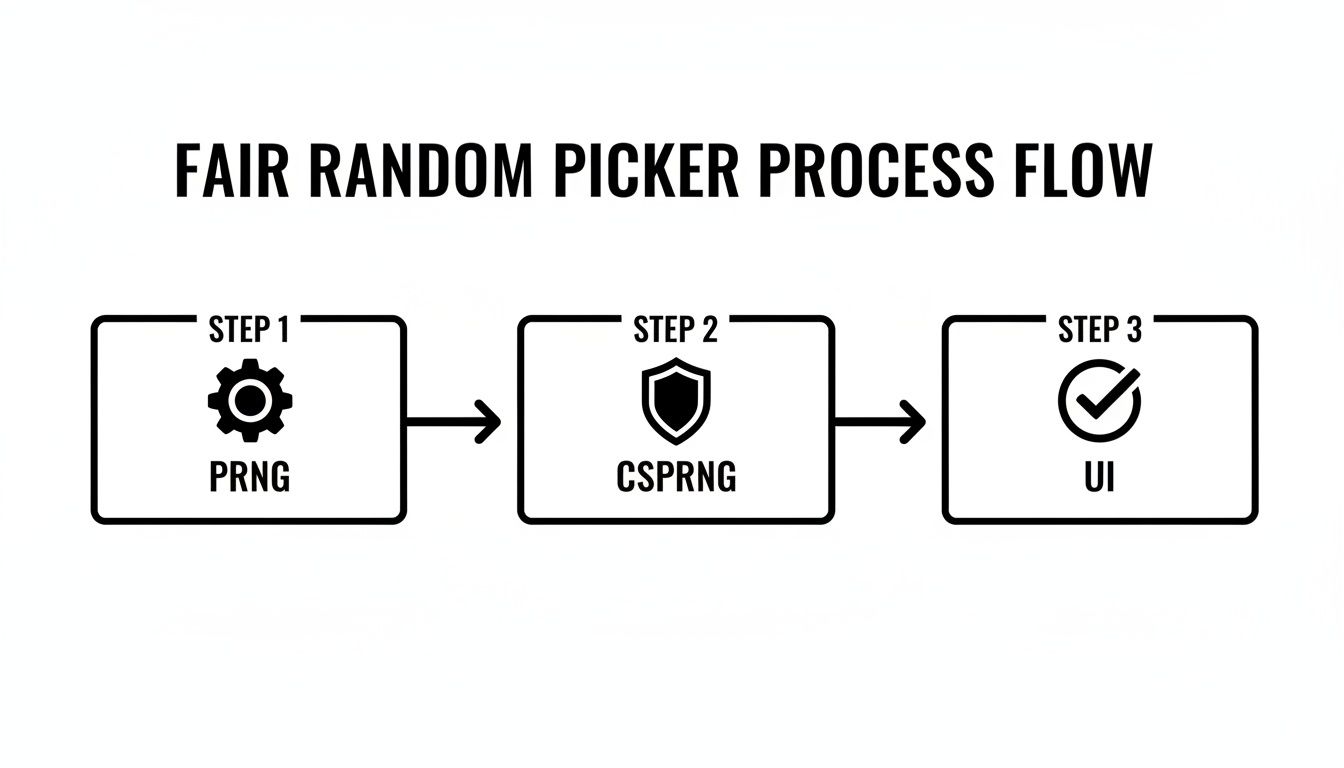
As you can see, shifting from a simple PRNG to a CSPRNG is the critical move here. It’s what ensures the final result displayed to the user is verifiably fair.
Implementing Key Features for a Better Experience
A tool that just picks one name is fine, but adding a couple of thoughtful features can make it indispensable. Two of the most common requests I see for a name picker random tool are a "no-repeat" mode and the ability to draw multiple winners.
- No-Repeat Mode: This is essential for things like assigning weekly tasks. You don't want the same person getting picked twice in a row. The logic is simple: once a name is picked, we just remove it from the array before the next draw.
- Multiple Winners: Sometimes you need more than one winner for a giveaway or a team raffle. We can easily add a small input field letting the user decide how many names to draw. Then, we just loop our selection function until we have the right number of unique winners. For numbered raffle tickets, a random number generator with no repeats draws distinct winning numbers.
These aren't huge changes, but they transform a basic script into a flexible utility. Building in user-centric features like these is a core principle in any development project. In fact, many of the same ideas apply even on a much larger scale, like when you're building a mobile app from idea to launch.
To help you keep track, here’s a quick checklist of the core features we're building and the key technologies behind them.
Feature Implementation Checklist
This table summarizes the core functionality, its purpose, and the primary JavaScript APIs you'll be using to bring each piece to life.
| Feature | Purpose | Key Technology/API |
|---|---|---|
| Name Input | Allow users to enter a list of names for the drawing. | HTML <textarea>, document.getElementById() |
| Data Processing | Convert the raw text input into a clean array of names. | String.prototype.split(), Array.prototype.filter() |
| Secure Randomization | Generate a truly random and unpredictable index for selection. | window.crypto.getRandomValues() |
| Winner Display | Show the selected name to the user clearly. | Element.textContent, DOM manipulation |
| No-Repeat Mode | Prevent the same name from being drawn multiple times. | Array.prototype.splice() |
| Multiple Winners | Allow users to select more than one winner from the list. | for loop, user input from <input type="number"> |
| UI Animation | Add visual excitement and feedback during the selection process. | CSS Animations (@keyframes), Element.classList |
Putting these pieces together creates a robust and user-friendly tool that goes beyond a simple script.
Pro Tip: If you decide to add a file upload option (like for a CSV of names), use the browser's FileReader API. It lets you read the file's contents directly in the user's browser without ever uploading it to a server. This is a huge win for keeping the tool completely private and secure.
Finally, a little bit of polish goes a long way. Some simple CSS animations, like a "spinning" effect that rapidly cycles through the names before landing on the winner, can make a huge difference. It adds a bit of drama and visual feedback, making the whole process feel more engaging and legitimate. It’s a small touch that turns a functional script into a professional-feeling application.
Putting Your Tool to Work in the Real World
So, you’ve built a secure and functional tool. Now for the fun part: seeing how it solves real business challenges. A privacy-first name picker random tool is more than just a fun gadget for classroom giveaways; it's a vital utility for any organization that takes data integrity and fairness seriously. Because it runs entirely offline, you can use it for sensitive tasks without a second thought.

Think about a marketing team running a social media raffle. Instead of copying and pasting hundreds of names into a random third-party website—and creating a potential data privacy nightmare—they can just use their own offline tool. This simple switch ensures no customer data ever leaves their machine, making the entire contest compliant and auditable right from the start.
Agile Teams and Unbiased Operations
In the world of software development, fairness isn't just a nice-to-have; it directly impacts team morale and productivity. Agile teams can use a local name picker to systematically remove unconscious bias from their daily routines.
- Daily Stand-ups: Who goes first today? Randomizing the speaking order for daily stand-ups ensures everyone gets a fair shake, preventing the same few voices from always setting the tone. For a complete running order, randomize the speaking order once, then work down the numbered list so every entry gets a turn.
- Code Reviews: It's easy to fall into the habit of assigning pull requests to the same senior devs. A random assignment distributes the workload evenly and encourages broader knowledge sharing across the team.
- Pair Programming: Need to create pairs for a coding session? A quick, fair shuffle is just a click away, fostering collaboration between different team members who might not normally work together. You can also create random groups for pair programming. Choose the number of groups and review the assignments before starting; groups are balanced by headcount, not by experience or skill. For fixed pairs, the random team generator lets you set People per team to 2.
These small changes help eliminate any hint of favoritism and reinforce a culture where everyone feels equally valued. If you want a ready-made solution that follows these principles, you can check out our privacy-first random name picker at Digital ToolPad.
High-Stakes HR and Management Decisions
The need for verifiable fairness gets even more serious when it comes to HR and management decisions. A client-side tool provides the lockdown security needed for selections where impartiality isn't just preferred, it's required.
Take something like random, mandatory compliance audits or drug screenings. The process needs to be completely defensible. By using a secure, verifiable randomizer, you can prove the selection was impartial, all while ensuring sensitive employee data never touches an external service.
Another great use case is forming unbiased project teams. When kicking off a new cross-departmental initiative, a random selection from a pool of qualified people can break down silos and bring in fresh perspectives that you might have otherwise missed.
The real power of a client-side name picker is its ability to provide auditable proof of fairness for sensitive decisions, all while guaranteeing that the underlying data never leaves the organization's control.
The adoption of these tools is on the rise. A 2021 survey found that 63% of teachers use digital randomizers weekly to reduce bias, with a striking 35% reporting it cut perceived favoritism by more than half. This same principle scales perfectly to corporate environments, where unbiased processes are just as crucial for team dynamics and compliance. You can find more insights on the effectiveness of random name pickers and their surprisingly broad applications.
Integrating Your Picker into a Larger Workflow
A great tool is one thing, but one that fits perfectly with your other tools? That’s where the magic happens. Your new privacy-first name picker random tool is powerful on its own, but its real value shines when you start thinking of it as one piece of a bigger, secure workflow. This is why having an interconnected, browser-based toolkit is so important.
Let's say you're running a contest and the entries come in from an API as a JSON file. Instead of struggling with that format or, worse, uploading it to some random online converter, you can just use another local tool. A simple JSON to CSV converter, for example, can reformat everything right in your browser. No user data ever has to leave your machine.
Preparing Your Data Securely
A fair draw starts with a clean list. It's a simple truth. Before you even think about pasting names into the picker, you should run them through a few prep stages using other browser-based utilities. This isn't just about being tidy; it's about guaranteeing the integrity of your selection, which is absolutely critical in any professional setting.
Here are a few practical ways you can build out a secure data preparation pipeline:
- Deduplication: Use a local text tool to hunt down and eliminate duplicate entries. This is step one for making sure everyone has a fair shot.
- Cleanup and Formatting: A find-and-replace or line-sorting utility can be a lifesaver. Use it to standardize names and get rid of any weird whitespace or characters that snuck in.
- Data Extraction: If your names are buried in a spreadsheet column or a more complex file, a local data extractor can pull just the information you need into a clean, simple list.
By chaining together these simple, single-purpose tools, you create a comprehensive and secure workflow for any task that demands speed and reliability, all without ever sending a single byte of data to an external server.
Building a Local-First Ecosystem
This whole approach gets back to the core idea of a privacy-first toolkit. Each tool—whether it's a text cleaner or your name picker random utility—is a self-contained, secure module. You can mix and match them to build custom solutions for all sorts of tasks, all while knowing your data stays completely under your control from start to finish.
This modularity is incredibly powerful. Imagine a marketing team's workflow: convert API data, clean the list, remove duplicates, and then feed that polished list into the picker for the grand prize drawing. Every single step is transparent, secure, and happens entirely offline. That's a level of trust that cloud-based services just can't offer, and it's the real advantage of a true local-first ecosystem.
Common Questions About Building a Name Picker
When you start digging into building your own random name picker, the same few questions always seem to pop up. These are the details that separate a simple script from a genuinely trustworthy tool, especially when developers or security-minded folks get involved.
Let's tackle them head-on.
How Can I Prove the Selection Was Truly Fair?
This is the big one. Anyone who's ever lost a raffle wants to know the draw was legitimate. Real, verifiable fairness boils down to one critical component: a Cryptographically Secure Pseudo-Random Number Generator (CSPRNG).
Thankfully, modern browsers give us this right out of the box with the crypto.getRandomValues() API. This isn't your standard Math.random(), which can be predictable. A CSPRNG is built for situations where true, unpredictable randomness is a must.
If you need an audit trail—say, for a compliance check or a high-stakes giveaway—you can log the key ingredients of the draw:
- The original, full list of names.
- The seed value you used (if you're using a deterministic approach).
- The exact random number that was generated to pick the winner.
This gives you a transparent, verifiable record. It’s a simple way to prove the result wasn't tampered with and came from a secure source.
Is a Client-Side Name Picker Secure for Sensitive Company Data?
Yes, and honestly, it’s the most secure way to do it. When the entire tool runs locally in your web browser, sensitive data like employee lists, customer emails, or project names never leaves your machine.
There’s no server to send the data to, which means no risk of it being intercepted, logged, or breached on the other end. This client-side approach is perfect for organizations that need to meet strict compliance standards like GDPR.
You're shifting the trust model. Instead of relying on a third-party company's security promises, you're depending on the heavily sandboxed, secure environment of your own browser. That’s a much stronger security posture.
Can This Tool Handle Very Large Lists Without Crashing?
Absolutely. It's a common concern, but modern JavaScript engines are incredibly fast. The actual logic for picking a name—generating a random number and grabbing an item from an array—is computationally trivial.
Even with tens of thousands of names, this operation takes just a few milliseconds. Where you might see a slowdown is in rendering the UI, especially if you have fancy animations. But the core selection process itself? It's lightning-fast and can handle massive lists without breaking a sweat.
Ready to build your own privacy-first tools? Digital ToolPad offers a suite of powerful, 100% offline utilities that run entirely in your browser, ensuring your data always stays with you. Explore our tools and see the difference at https://www.digitaltoolpad.com.