
A UUID random generator is a tool that creates a Universally Unique Identifier by drawing from a source of random numbers. The goal is simple but critical: to generate an ID that is, for all practical purposes, one-of-a-kind in the entire world, without having to check in with a central authority. These identifiers, particularly the popular UUIDv4, are the unsung heroes of distributed systems, database keys, and secure transaction logs where uniqueness is absolutely non-negotiable.
Why Modern Projects Rely on UUID Random Generators
Think about any modern application, whether it's a mobile app or a sprawling microservices architecture. They all need a foolproof way to create unique identifiers. How do you tag a user's session, a new database record, or a critical transaction log so it can never be mistaken for another?
This challenge gets even tougher in distributed systems, where multiple servers are working in parallel. Without a central "ID manager" coordinating everything, what stops two different servers from accidentally creating the exact same identifier at the exact same time?
This is precisely the problem a UUID random generator solves, and it does so with elegance and efficiency. Instead of relying on sequential numbers—which can create performance bottlenecks and even leak business metrics—developers have overwhelmingly adopted UUIDs for their decentralized, collision-resistant design.
The Power of Astronomical Uniqueness
Before we dive deeper, let's get a feel for what a Version 4 UUID really is.
UUID Version 4 At a Glance
| Attribute | Description |
|---|---|
| Type | Randomly Generated |
| Bits of Randomness | 122 bits |
| Total Bits | 128 bits (6 bits are fixed for version and variant) |
| Total Possible IDs | Approximately 5.3 x 10^36 (5.3 undecillion) |
| Collision Probability | Extremely low; practically zero for most applications. |
| Primary Use Case | Generating unique IDs without a central coordinator. |
The sheer scale of this is what makes it work. With 122 bits of pure randomness, you have a staggering 5.3×10^36 possible unique identifiers to work with. That number is so vast it's hard to wrap your head around.
To put it in perspective, you would need to generate about 2.71 quintillion (2.71×10^18) UUIDs just to reach a 50% chance of a single collision. This incredible reliability is what allows tools to function without ever needing to coordinate with a server. Every task gets a guaranteed unique ID, instantly and offline. For a deeper dive into the math, Wikipedia's page on UUIDs is a great resource.
In real-world terms, it's more likely that a cosmic ray will flip a bit in your server's memory than for you to generate a duplicate UUIDv4. This level of reliability allows developers to build with confidence, knowing their identifiers are globally unique.
Privacy and Security in Generation
The generation process itself is a critical security consideration. Plenty of online tools can spit out a UUID, but many of them work by sending a request to a server. For any team handling sensitive information, that's an immediate red flag.
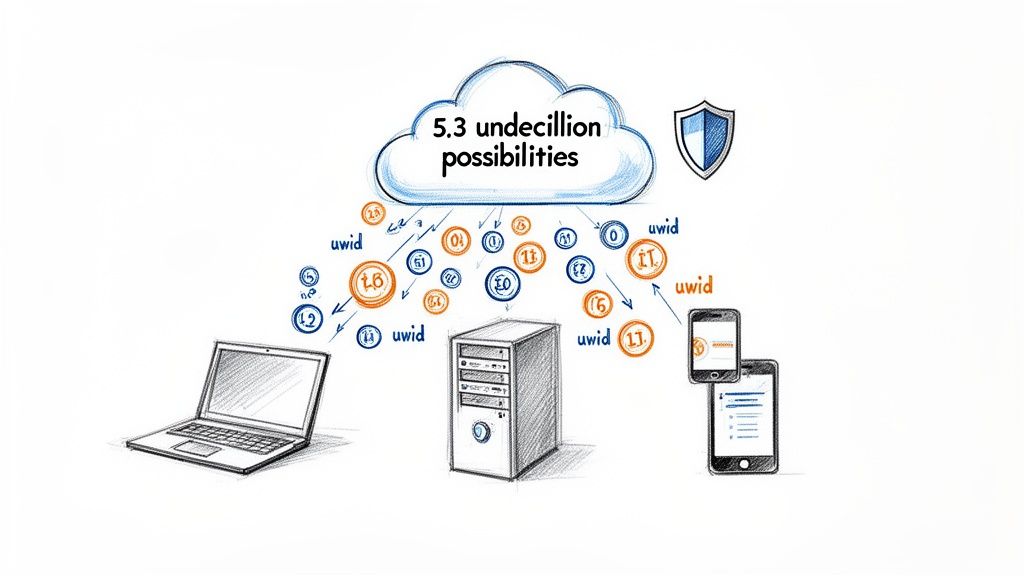
This diagram illustrates a common flow where IDs are distributed from a central source, but it also underscores the need for security in that process.
This is why privacy-first, offline tools like Digital ToolPad's UUID generator are so valuable. By performing all the calculations directly within your browser, no data ever leaves your machine. This client-side approach guarantees the generation process is not only instant but also completely secure, satisfying the stringent compliance and privacy requirements of today's enterprises.
Generating Secure UUIDs Offline with Digital ToolPad
When you need a quick UUID, it's tempting to just google "UUID generator" and use the first result. The problem? Most of those tools run on a server. Every time you generate an ID, your request could be logged, tracked, or even monitored. If you're dealing with sensitive information—like internal audit logs or customer IDs for a staging environment—that's a risk you just can't take.
This is where a client-side generator changes the game. By using a privacy-first offline tool, you can be certain that 100% of the processing happens right inside your browser. Nothing ever gets sent over the internet, giving you complete confidentiality.
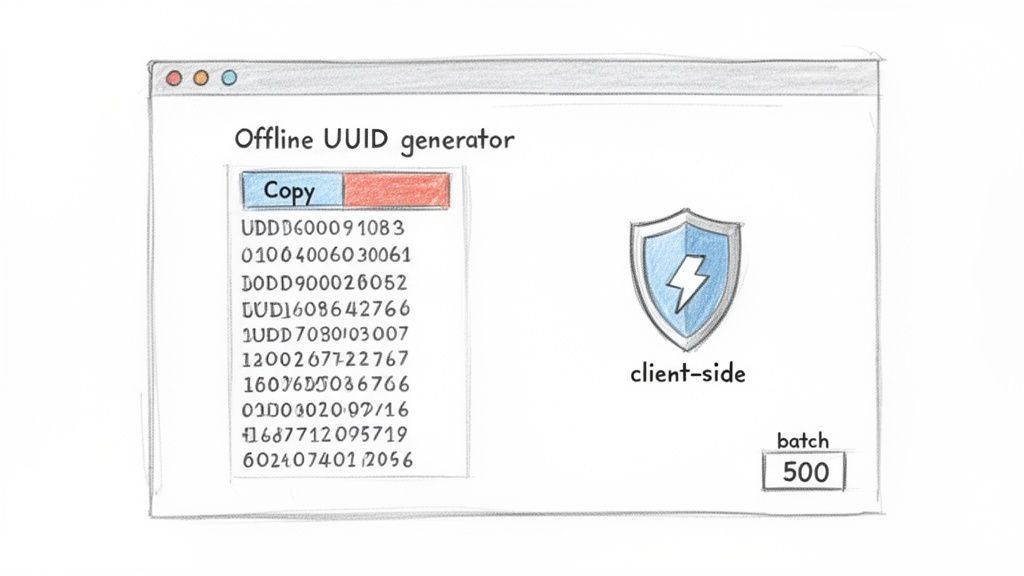
It’s the best of both worlds: the convenience of a web tool with the security of a local app. It's an approach that's perfect for developers, security analysts, and anyone who takes data privacy seriously.
Practical Scenarios for Offline Generation
Let's get practical. The real value here isn't just about grabbing a single ID. It’s about securely handling specific, often large-scale, tasks without any friction.
Picture this: you're a developer getting ready to seed a new test database. You need 500 unique IDs for the user table before you can kick off your integration tests. Instead of spinning up a script, you can generate the whole batch in an instant.
- Need just one UUID? The page loads with a fresh, cryptographically secure UUIDv4 already waiting for you. One click, and it's on your clipboard, ready to be pasted into a config file or an API call.
- Need a lot of them? If you need IDs in bulk, you can just tell the tool how many you want—whether it’s 10 or 10,000—and it generates them on the spot. They appear in a clean list, so you can easily copy and paste them into a CSV, a JSON file, or right into a database script.
This kind of functionality is a lifesaver in situations where you need to move fast without compromising on privacy. You can see it in action by trying out the offline UUID generator on Digital Toolpad for yourself.
Why Client-Side Processing Is So Important
The difference between a server-side and a client-side uuid random generator isn't just a technical detail; it's a critical security boundary. An offline tool works by tapping into your browser's built-in cryptographic functions (window.crypto), which are specifically designed to be both secure and unpredictable.
By leaning on your browser's native crypto library, a client-side generator ensures that sensitive operations never leave your local machine. This single design choice sidesteps risks like man-in-the-middle attacks, server logs, or data breaches that can plague online tools.
This approach delivers some serious benefits:
- Total Privacy: Your requests never travel across the network. What you generate stays with you.
- Zero Latency: Since there’s no network roundtrip, generation is instantaneous.
- Compliance-Friendly: Helps you meet strict data privacy and sovereignty rules like GDPR.
For any organization that puts a premium on data security, using a client-side, offline generator isn't just a nice-to-have. It’s a core part of responsible development, ensuring that creating unique identifiers remains a secure, internal process.
Generating UUIDs: A Look Across Different Environments
While clicking a button in a browser tool is great for quick, one-off needs, professional development demands generating UUIDs right where you work—within your tech stack. Whether you’re building a web front-end, a backend service, or just automating tasks in the terminal, there’s a native way to get the job done.
The secret sauce behind all these methods is their reliance on a cryptographically secure pseudo-random number generator (CSPRNG). This isn't your average Math.random(). A CSPRNG taps directly into your operating system's entropy pool, pulling from sources like mouse movements, network packet timing, and other unpredictable system events. This is what makes the resulting IDs truly random and secure.
How to Generate UUIDs in Your Favorite Programming Language
Most modern languages come with built-in, battle-tested libraries for creating Version 4 UUIDs. This is a huge win because it means you don't have to reinvent the wheel—you can just lean on code that's already proven to work correctly and securely with the system's CSPRNG.
Here are a few practical, copy-and-paste examples for some of the most common languages out there.
JavaScript (Browser and Node.js)
In the JavaScript world, the crypto module is the gold standard for anything security-related. The best part? It's available natively in both modern browsers (as window.crypto) and Node.js.
// This works in both browser and Node.js environments const newUuid = crypto.randomUUID();
console.log(newUuid); // Example output: '7e2c9e47-4f49-4a49-813c-1b6b6d5f7331' That one line is all it takes. It’s clean, efficient, and—most importantly—secure by default.
Python
Python developers can turn to the standard library's versatile uuid module. Generating a v4 UUID is as simple as calling a single function.
import uuid
Generate a Version 4 UUID
new_uuid = uuid.uuid4()
print(new_uuid)
Example output: UUID('f81d4fae-7dec-11d0-a765-00a0c91e6bf6')
Heads up: this returns a UUID object, not a string. If you need the string representation, just wrap it in str(new_uuid).
Java
Java has had a rock-solid method for UUID generation for years, baked right into its java.util.UUID class.
import java.util.UUID;
public class UuidGenerator { public static void main(String[] args) { UUID newUuid = UUID.randomUUID(); System.out.println(newUuid.toString()); // Example output: 'a4b9c1d2-0f1e-4a9b-8c7d-6e5f4g3h2i1j' } } This static method is thread-safe and a workhorse in enterprise Java applications, used for everything from database primary keys to unique transaction tokens.
Need a UUID Fast? Use the Command Line
Sometimes you just need a unique ID right now and don't want to spin up a code editor. If you're a DevOps engineer, a sysadmin, or just someone who lives in the terminal, you're in luck. Most operating systems have built-in utilities for this.
Linux and macOS: The classic
uuidgencommand is your friend. Just type it and hit enter. $ uuidgenOutput: 3E2A6C40-9B2A-4F18-A3A4-12F5A9A7611A
Windows (PowerShell): PowerShell makes it just as easy with the
[guid]type accelerator. PS> [guid]::NewGuid()Output:
Guid
----
0f8fad5b-d9cb-469f-a165-70867728950e
These command-line tools are perfect for scripting, generating secrets for environment files, or any time you need an ID on the fly. And if you're deep in development and prefer a web UI, you might also find our guide to get a UUID online useful for those quick-grab situations.
No matter the environment—a browser, a backend service, or a terminal—the fundamental principle is the same. The
uuid random generatorfunction you call is just a clean interface to the operating system's core source of entropy. This ensures consistent security and randomness across the board.
Knowing how to generate UUIDs in different contexts is a powerful skill. It’s all about picking the right tool for the job while trusting the underlying cryptographic foundation that makes UUIDv4 so incredibly reliable.
Picking the Right Tool for the Job: Random vs. Deterministic UUIDs
When developers reach for a uuid random generator, they're almost always after one thing: a unique identifier that won't clash with anything else. This is the domain of Version 4 (v4) UUIDs, which are cooked up from a batch of pure randomness. But sometimes, randomness is the last thing you want. You need predictability.
That’s the fundamental split between random and deterministic UUIDs. Think of a v4 UUID as a unique snowflake—you'll never generate the same one twice. A deterministic UUID, like Version 3 or Version 5, is the complete opposite. It’s created from a specific input string, and if you feed it the same input, you get the exact same UUID back, every single time. This feature is a lifesaver in certain situations.
Take API design, for instance. To stop a client from accidentally creating duplicate orders with a double-click, you can use an idempotency key. By generating a v5 UUID from the user's ID and the request details, you create a stable identifier for that specific action. If the same request comes in again, it produces the same UUID, and your system can safely recognize and ignore the duplicate.
Uniqueness vs. Repeatability: When to Use Each
So, how do you decide? It really boils down to what you're trying to achieve. Are you creating a new record in a database that needs a one-of-a-kind ID? Or are you trying to create a stable, repeatable identifier that's tied to a specific piece of data?
The diagram below maps out where these different generation methods fit into common development environments, from the browser to the command line.
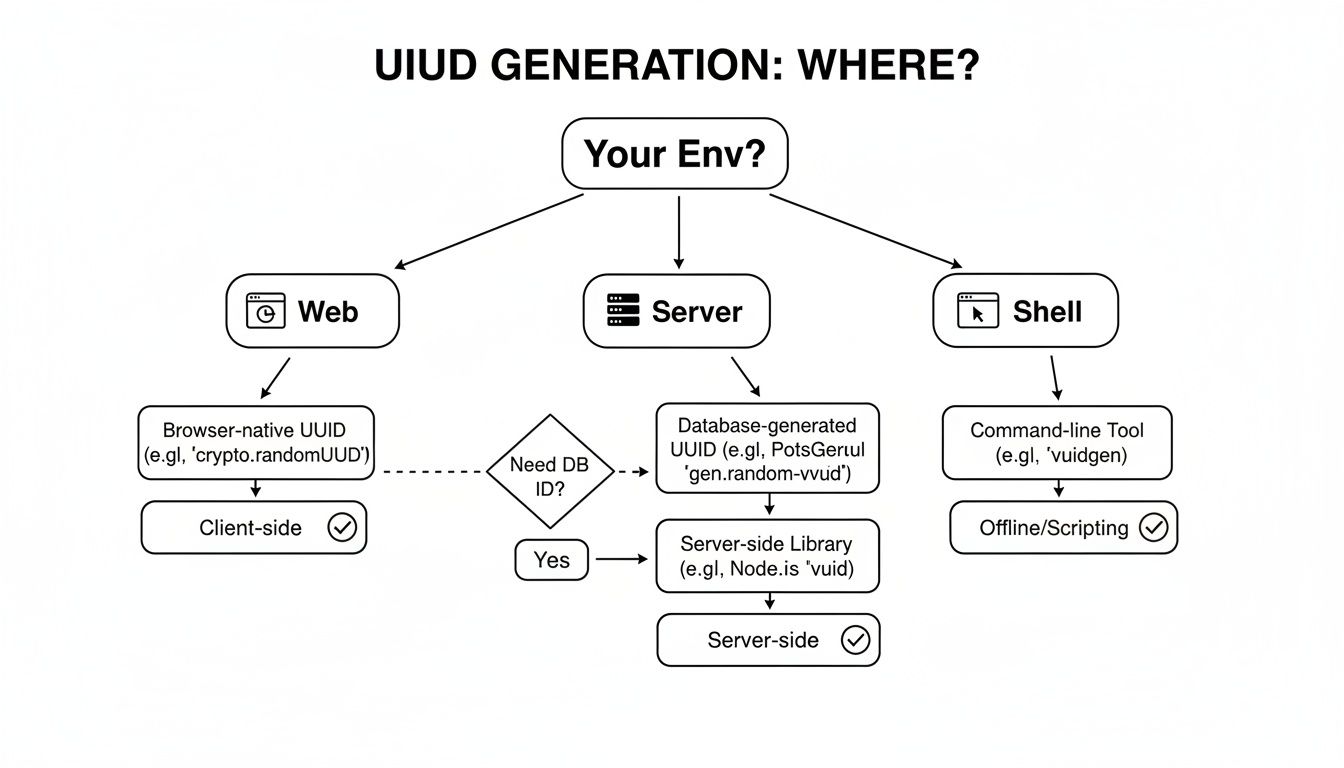
While the environment can influence your choice, the core decision between random and deterministic is a fundamental part of your application's logic.
To make that choice crystal clear, let's break down the differences side-by-side.
Comparison of UUID Types: Random vs. Deterministic
This table really gets to the heart of the matter, comparing how these two types of UUIDs are made and what they're best used for.
| Characteristic | Random UUID (Version 4) | Deterministic UUID (Version 3/5) |
|---|---|---|
| Generation | Based on random numbers from a CSPRNG. | Generated by hashing a namespace and a name. |
| Uniqueness | Each generation produces a new, unique ID. | The same input always produces the same ID. |
| Collision Risk | Practically zero; requires no coordination. | Collisions only occur if different inputs hash to the same value (extremely rare with v5/SHA-1). |
| Common Use Cases | Database primary keys, transaction IDs, session identifiers. | Idempotency keys, content-addressable storage, URL-based identifiers. |
The main takeaway here is pretty straightforward. Choosing the right type isn't about which one is "better," but which one fits the problem you're solving right now.
Use a random UUID generator (v4) when you need an identifier that is guaranteed to be unique and unpredictable. Opt for a deterministic UUID (v5) when you need a stable, repeatable identifier derived from a known piece of data.
What's Next? A Look at UUIDv7
It's also worth keeping an eye on emerging standards like UUIDv7. This new version cleverly mixes a Unix timestamp with a splash of random bits. The result is an identifier that's not only unique but also sortable, which can give you a nice performance boost for database indexing compared to the purely random v4. For anyone building high-throughput systems, it's definitely one to watch.
Avoiding Common Security and Performance Pitfalls
Grabbing a random UUID seems simple enough, but a few hidden gotchas can lead to serious security holes or bring your application's performance to its knees. The biggest mistake I see developers make is assuming all "random" is truly random. It's not, and that distinction is absolutely critical.
The Illusion of Randomness
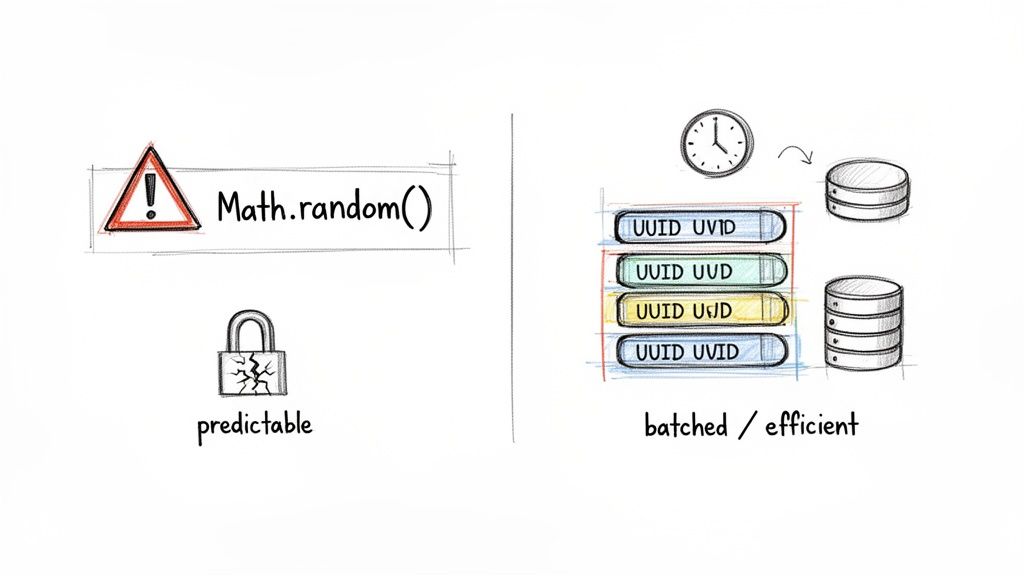
From a security standpoint, the number one danger is using a non-cryptographic random number generator. The classic example is JavaScript's old Math.random(). Sure, the numbers it spits out look random, but they're generated from a predictable algorithm. An attacker who sees enough of these "random" UUIDs could potentially figure out the pattern and start guessing future ones. This is how vulnerabilities like session hijacking happen.
That’s why any modern UUIDv4 implementation worth its salt uses a Cryptographically Secure Pseudo-Random Number Generator (CSPRNG). Instead of just running an algorithm, a CSPRNG hooks into the operating system’s entropy pool—a chaotic mix of unpredictable data from things like hardware timings, mouse movements, and network packet arrivals—to generate identifiers that are genuinely unpredictable.
The Hidden Performance Tax of High-Frequency Generation
While security is non-negotiable, performance can become a real headache in high-throughput systems. The very source of UUIDv4's strength—its reliance on system entropy—can also be its Achilles' heel. Every time your application requests a cryptographically secure random number, it has to make a syscall to the operating system.
A single syscall isn't a big deal. But what if your system is hammering out thousands of UUIDs every second for new database records or event stream messages? Those "cheap" syscalls start to add up, putting a surprising amount of strain on the CPU.
We saw a perfect, real-world example of this when the team at CockroachDB investigated a performance issue. Their gen_random_uuid() function was taking 811 nanoseconds per call—a whopping 15 times slower than an optimized alternative. The culprit? The getrandom syscall was being invoked up to 6 million times in one workload. It’s a stark reminder that v4’s security-first design can have serious performance implications at scale. You can dig into the full technical details of the CockroachDB performance issue on GitHub.
Smart Ways to Stay Fast and Secure
So, how do you get the security of a CSPRNG without bogging down your whole system? It all comes down to being a bit more strategic.
- Generate UUIDs in Batches: Instead of asking for one ID at a time, request a whole batch. This drastically cuts down on the number of syscalls, spreading the performance cost over many IDs instead of just one.
- Look at Time-Ordered Alternatives: When you're using UUIDs as primary keys in a database, the pure randomness of v4 can lead to index fragmentation and slower inserts. Newer formats like ULIDs or UUIDv7 offer a brilliant solution by combining a timestamp with random bits. They're still unique, but they're also sortable, which keeps your database indexes happy.
- Profile Your Code First: Don't just assume UUID generation is your bottleneck. Before you start optimizing, use a profiler to see where your application is actually spending its time. You might be surprised.
The core takeaway is to be intentional. For the vast majority of applications, a standard UUIDv4 generator is perfectly fine. But if you're building a system that needs to operate at the edge of performance, understanding these trade-offs is what separates a good architecture from a great one.
By steering clear of predictable randomness and being mindful of how often you generate IDs, you can use UUIDs effectively without falling into these common traps. For a deeper dive into building secure software, check out our guide on software development security best practices.
Frequently Asked Questions About Random UUIDs
When you start working with UUIDs, a few key questions pop up time and time again. Let's clear the air on some of the most common ones so you can use these identifiers with confidence.
Are Browser-Generated UUIDs Actually Secure?
The short answer is yes, but there's a huge "if" attached. They are secure if they're created using a cryptographically secure pseudo-random number generator (CSPRNG).
Thankfully, modern browsers give us exactly that with the window.crypto.getRandomValues() API. This function taps directly into the operating system's most reliable sources of randomness, making the generated UUIDs genuinely unpredictable. This is what makes them safe enough for security-sensitive work. Just be sure to steer clear of old-school methods like Math.random(), which is predictable and absolutely not secure for this purpose.
A quick but important note: A statistical generator like
Math.random()can be a security nightmare. Attackers can potentially predict the sequence of numbers it produces. A proper Version 4 UUID absolutely requires a CSPRNG, which gathers its randomness (entropy) from things like hardware timings and system events, making it practically impossible to guess.
What’s the Real-World Chance of a UUID Collision?
For all practical purposes, it’s zero. The probability is so incredibly low that it’s something you can safely ignore in almost any application.
A Version 4 UUID has 122 bits of randomness, which translates to a mind-boggling 5.3 undecillion possible combinations.
To put that into perspective, you would have to generate over 2.71 quintillion UUIDs (that's 2.71 x 10^18) just to have a 50% chance of a single collision. Even if you were creating one billion UUIDs every single second, it would still take you more than 85 years to reach that 50% probability mark. It’s this astronomical unlikelihood that makes them so reliable for distributed systems where a central authority for IDs just isn't feasible.
When Should I Use a UUID Instead of an Integer?
You'll want to reach for a UUID whenever you need to create unique IDs without a central coordinator. This is especially common in modern architectures where a simple, auto-incrementing integer would either be impossible or create a major performance bottleneck.
They are a perfect fit for:
- Microservices Architectures: Each service can generate its own IDs without needing to ask permission from another.
- Offline-First Applications: A user's device can create new records offline, and you can sync them later without worrying about ID conflicts.
- Multi-Master Database Replication: When you have multiple database masters, each can write new records with unique IDs that won't clash when everything is merged.
Simple integers are fine for monolithic, single-database apps. But UUIDs also offer a nice security perk: they don't leak business intelligence. An ID like /users/452 tells a competitor you have at least 452 users. An ID like /users/a4b9c1d2-0f1e-4a9b-8c7d-6e5f4g3h2i1j tells them absolutely nothing.
For all your development needs, from generating secure UUIDs to converting data formats, trust Digital ToolPad to deliver fast, private, and offline tools that keep your data on your machine. Explore our full suite of utilities at https://www.digitaltoolpad.com.